Typically, the beneficiation of metallic ores involves processes such as crushing, screening, ball milling, flotation (and magnetic separation), and tailings disposal. Throughout these operations—grinding and classification, cyclone overflow, thickener underflow, tailings conveyance, and tailings backfilling—the concentration of the slurry must be measured.
The primary methods for measuring slurry concentration today include radioactive concentration meters, exempted radioactive concentration meters, the sampling‑weighing method, and ultrasonic concentration meters.
Radioactive concentration meters operate on the principle that when a beam of radiation passes through the material being measured, its intensity diminishes; the degree of attenuation depends on the concentration within the measurement path and in the material itself. With a fixed measurement path, the concentration can be determined by quantifying how much the radiation is attenuated by the material. These instruments offer high accuracy, a wide measurement range, and minimal maintenance—but the presence of a radioactive source poses environmental and safety risks, and its approval, use, and storage are highly regulated and cumbersome.
Exempted radioactive concentration meters require registration with the environmental protection authorities, making their oversight relatively straightforward. They are easy to install and deliver good accuracy under stable slurry conditions. However, the presence of bubbles or turbulence can lead to measurement instability. More critically, while the low radiation intensity has earned exemption from stringent regulatory control, the short half‑life of the source—typically about 2.6 years—necessitates replacement, with the cost of the radioactive source accounting for one‑quarter of the purchase price, driving up maintenance expenses.
The weighing method entails manually sampling the slurry, directly weighing it to determine the bulk density, and then calculating the concentration based on the known densities of the components. This approach is discontinuous, labor‑intensive, subject to human error, and struggles to ensure consistent accuracy.
Ultrasonic slurry concentration meters measure concentration by assessing the attenuation of an ultrasonic wave as it passes through the slurry; the degree of attenuation correlates with the slurry’s concentration. However, these instruments are often affected by bubbles, leading to unstable readings, and their measurement range is typically limited to concentrations below 50% by mass.
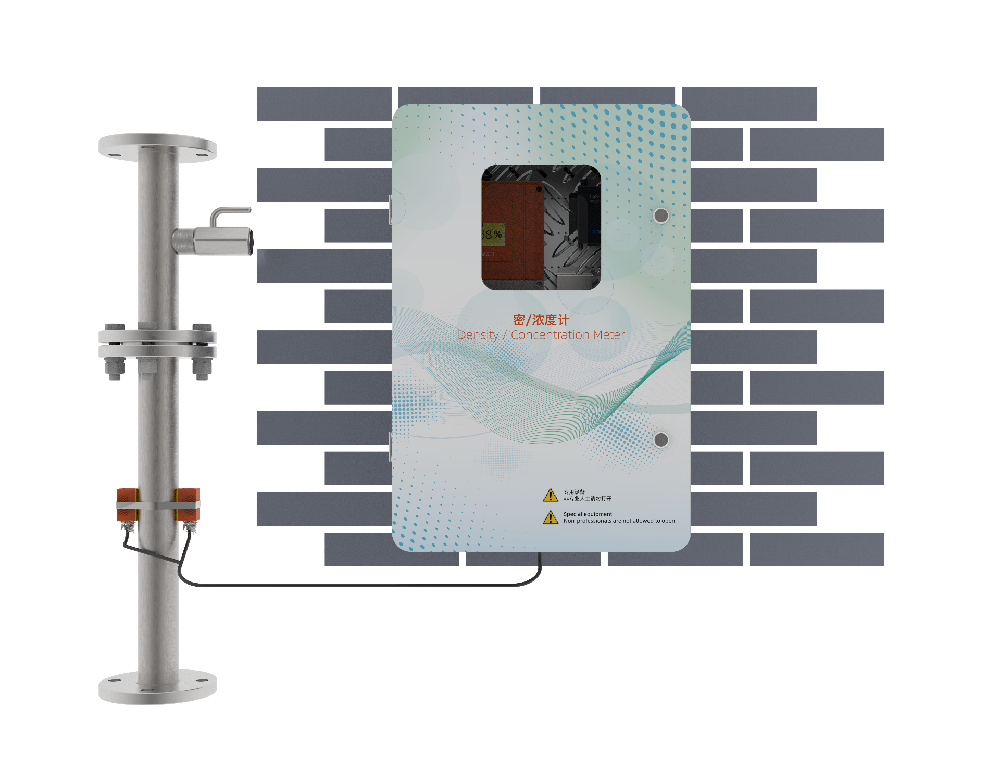
The acoustic impedance slurry concentration meter developed and manufactured by Pisonics in Xi’an employs the ultrasonic acoustic impedance principle. The sensor emits an ultrasonic wave; when the slurry contacts the probe, energy is transmitted into and reflected from the interface between the sensor and the slurry. By analyzing the transmitted and reflected energy, the instrument calculates the slurry’s concentration. This measurement principle is immune to bubble interference, ensuring stable and highly accurate results. It features a sapphire sensor with exceptional wear resistance and a pipe section lined with imported Nitrile rubber, enabling operation for over ten years.
The acoustic impedance slurry concentration meter is recommended for vertical installation. If installed horizontally or in self‑flow systems with less‑than‑full‑pipe conditions, a minimum flow velocity must be maintained to prevent particle settling at low velocities, which could compromise measurement accuracy.
Density meters, concentration meters, ultrasonic density meters, acoustic impedance density meters, acoustic attenuation density meters, sound velocity‑based density meters, tuning fork density meters, Coriolis force density meters, optical concentration meters, differential pressure density meters, Na22 density/concentration meters, microwave density meters/moisture analyzers, conductivity‑based density meters, and clamp‑on density meters—please stay tuned and contact Xi’an Pisonics Information Technology Co., Ltd. Our Chinese website: https://www.pisonics.cn; our English website: https://www.pisonics.com/
Contact: Manager Cui; Phone: +86 15902932017; Email: info@pisonics.com